Sachit with the 8th grade class
When the internet stopped working in Shanti Bhavan’s computer lab, Sachit, a new volunteer on campus, began looking for another way for students to practice typing.
The online program they relied on was unavailable. Rather than put the lesson on hold, he considered what they could use offline.
Sachit had spent the previous decade working in technology, including as a product manager at Google focused on artificial intelligence and its use in the classroom. At Shanti Bhavan, he drew on the same product mindset that helped shape his career. Understand the need, work within the constraints, and build something useful.
Why Sachit Chose to Volunteer
Sachit first learned about Shanti Bhavan while scrolling through LinkedIn. At the time, he had been thinking about how he could use his experience to serve others.
“I’m from India, but I was raised in the United States,” he says. “My entire life, the opportunities I’ve had were a product of chance. So many people in India don’t get those same opportunities simply because of where they’re born. I’ve always wondered, what can I do to help close that gap?”
That question eventually brought him to our campus in Tamil Nadu, where he spent several months volunteering.
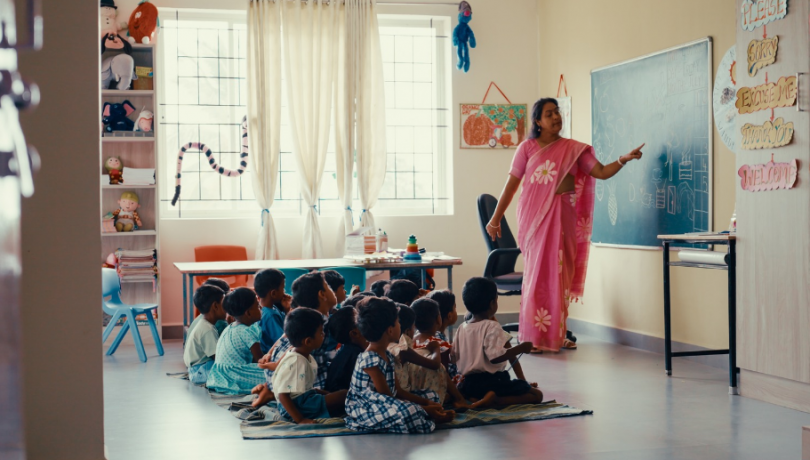
Sachit taught computer literacy to fourth- and fifth-graders, public speaking to eighth-graders, and SAT math to 11th-graders. Each classroom gave him a different way to contribute, but the computer lab presented a problem especially suited to his background.
Working with our onsite team, Sachit spent a weekend fast-tracking the development and installation of an offline typing program. Within days, students were using it.
“It was a real joy watching them use it and get better,” he says.
Students played the typing games, practiced their skills, and shared feedback on the program. Sachit could see the results of the work almost immediately.

Posing with the 7th grade boys
Done Can Be Better Than Perfect
The tech industry has no shortage of familiar principles: Move quickly. Test, learn, iterate, repeat. Done is better than perfect.
Those ideas need more care in a school, where children are not test users and their education is not a product. Still, the best habits behind product work can do double duty. Pay attention to what people need, create something useful, and improve it over time.
Sachit didn’t arrive on campus with an offline typing program already planned. The idea came from being in the moment, noticing what was getting in the way of learning, and recognizing that he had the skills to help.
Opportunities like this exist throughout the year at Shanti Bhavan. Volunteers bring experience from technology, business, the arts, and many other fields. Their most useful contributions often take form after they arrive and spend time with students and staff, learning and discovering their needs.
Some ideas become new lessons or workshops, and others solve a practical problem. Many begin with two simple questions: What do I know how to do, and where could it be useful here?
Learning Beyond the Project
While the typing program gave Sachit a tangible way to contribute, some of the moments he remembers most are much smaller.
During dinner one evening, his plate was sitting slightly off-center on the table. Prashanth, then in fourth grade, noticed immediately.
“Sir, keep your plate nicely on the table,” he told him earnestly.
“It was such a small thing,” Sachit remembers. “But it showed such thoughtfulness. These little moments of selflessness stay with you.”
He noticed the same care throughout campus, especially among the youngest students.
“What surprised me most is how unconditional the kids’ interest, affection, and curiosity are,” he says.
They looked out for one another, asked questions confidently, and welcomed volunteers into their daily lives. Sachit came prepared to teach, but his time with the students also gave him plenty to learn.

Learning how to make chapati
Becoming Part of the Team
Living and working on campus gave Sachit a closer view of Shanti Bhavan’s educational model. He saw it in the consistent daily schedule, the relationships between students and staff, and the opportunities children have to explore their academic, creative, and personal interests.
“There is intention behind every single detail of that school,” he says.
Conversations with graduates helped him see where those details can lead.
“When you talk to the graduates and hear about their lives, it’s a moment of clarity,” he says. “You realize, ‘This works so well.’”
Within his first few weeks, Sachit felt that he had become part of the community.
“You can see how it’s achievable because you’re living it,” he says. “Even after just a month, I felt close to the organization. I felt like I was part of the team and the mission.”
Sachit’s experience is an invitation to consider where your own skills might be useful. You might arrive with one idea and discover a completely different opportunity once you are here.
Sometimes, it begins with a lesson you planned to teach. Sometimes, it begins when the internet goes down.

Jessica Ruiz
Manager of Volunteer Services at Shanti Bhavan